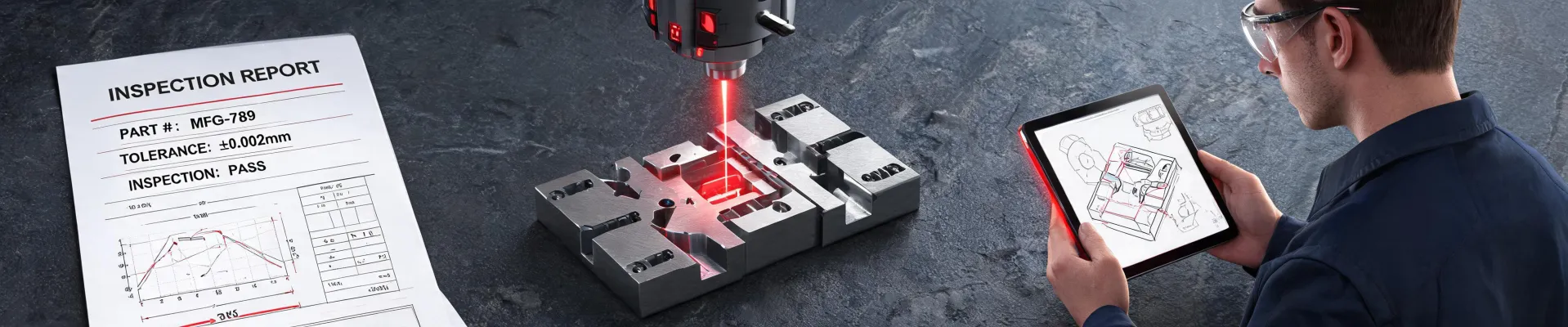
The quote sheet looks identical. The price doesn't.
Last month, three quotes came back on the same part. A 6061-T6 aluminum bracket, 500 pieces, same drawing revision, same anodize callout. The spread between lowest and highest was 38%.
The procurement lead asked me the obvious question: why aren't we taking the cheapest one?
Fair question. On paper, the three quote sheets were nearly indistinguishable. Same part number. Same material. Same finish. Same lead time, almost. When everything else lines up, price is the only variable left — and that's exactly the trap.
I've reviewed machined parts for a hardware company for the last four years — roughly 200 unique parts annually, every one of them before it reaches a customer. In our Q1 2024 audit, we rejected 12% of first article submissions. Not because the factories were incompetent. Because the sourcing process never defined what "good" meant.
What the quote sheet doesn't show you
Here's the thing about a quote: it's a number with no assumptions attached. And every number has assumptions — they're just buried.
1. The quote is a guess until someone engineers it
Unless a programmer or process engineer has actually opened your file and looked at the geometry, that price is an estimate built on pattern-matching. "Looks like a similar job we ran last year." Sometimes that's fine. Sometimes the setup is different, the fixturing is harder, and the real cost is 20% above what was quoted — which the factory will quietly absorb on the first order and make up on yours.
A good custom CNC machining service will send you DFM feedback with the quote. If they don't, ask for it.
2. "Within tolerance" is a wider door than buyers realize
If your drawing leaves the title block at its default, you're probably quoting to ISO 2768-m — the medium general tolerance class. It's a real standard (ISO 2768-1:1989), and for a lot of work, it's adequate. But look at what it actually allows: for a dimension between 30 and 120 mm, ±0.3 mm.
Now picture two parts assembled together. Your hole is at the top of that band. The mating pin is at the bottom. Each part met its spec. The assembly doesn't.
We ran a batch of 400 aluminum housings in 2023. Hole pattern was off by 0.15 mm — comfortably inside ISO 2768-m. The vendor said it was "within standard." They were right. The line still couldn't assemble the units. We ate $4,200 in rework on a $9,800 order and pushed a launch by three weeks.
3. Who actually reviewed your drawing?
This is the question almost nobody asks. At most CNC machining factories, the person who quotes is not the person who machines. On a good one, a process engineer signs off before the number goes out. On a bad one, a salesperson reads the print, matches it to a vaguely similar job, and adds a margin.
Ask. It changes the number. When you're comparing custom CNC machining services, this single question — who reviewed the print — separates quotes that hold up from quotes that get revised at first article.
4. Supplier matching is not price matching
When you go looking for a CNC machining manufacturer, sorting by quote is the intuitive move. It's also the one that gets you in trouble. The right factory for a five-axis aerospace bracket is not the right factory for a 200-piece aluminum enclosure. Matching by capability — machine envelope, materials, tolerance class, inspection equipment — is the whole game. Price is the output of that match, not the input.
Most CNC machining manufacturers will quote whatever file you send. Fewer will tell you whether that file is a good fit for their equipment before you commit.
What it actually costs when the cheap quote goes wrong
Here's where the math gets uncomfortable.
Rework
That $4,200 on the housing order wasn't just a line item. It meant re-machining, re-inspecting, re-packing. And it meant telling the customer the ship date moved.
Line stoppage
We've had a single out-of-spec part stop an assembly line. At that particular contract manufacturer, stoppage costs were around $6,000 a day. Two days of that and the "savings" from a cheaper quote are gone — twice over.
Time — the line item nobody quotes
The most frustrating part of sourcing isn't the bad part itself. It's the six weeks you lose re-quoting, re-ordering, and re-scheduling. You'd think a clear drawing would prevent this. But interpretation varies, and by the time you find out, you're already behind.
Looking back, I should have built a tolerance review into our sourcing checklist years before we did. At the time, it felt like overkill on simple parts. It wasn't.
The brand cost
Your customer never sees your CNC machining factory. They see your product. A scratch, a loose fit, a finish that doesn't match the sample — those are your brand problems, not your supplier's. I've watched a $200-per-part savings show up as a customer complaint about "quality inconsistency" six months later. That one's harder to price.
What actually works
Short version, because the problem is the point:
Ask for DFM feedback before you ask for price. A custom CNC machining service that won't review your file before quoting is telling you something.
Ask who reviews the print. Sales rep or process engineer. Different answer, different risk.
Spell out tolerances explicitly. Don't let ISO 2768-m be your accidental spec. If it matters, call it out.
Require first article and in-process inspection on anything you can't afford to redo. A quality certificate on the wall is a starting point, not a guarantee — ISO 9001 tells you a process exists, not that it works on your part.
Do the TCO math. Unit price × quantity is one number. Add rework risk, inspection time, and the cost of one late delivery. If the cheapest quote still wins on that math, take it. It rarely does.
The procurement lead took the middle quote. Not because it was the most comfortable number, but because that CNC machining manufacturer sent back DFM notes on the print before we asked — three callouts, one of which would have caused a fixture problem on the first run. That reply was worth more than the 38% spread.
Price is the easiest thing to compare. It's also the thing that tells you the least about Custom CNC Machining Service Sourcing.