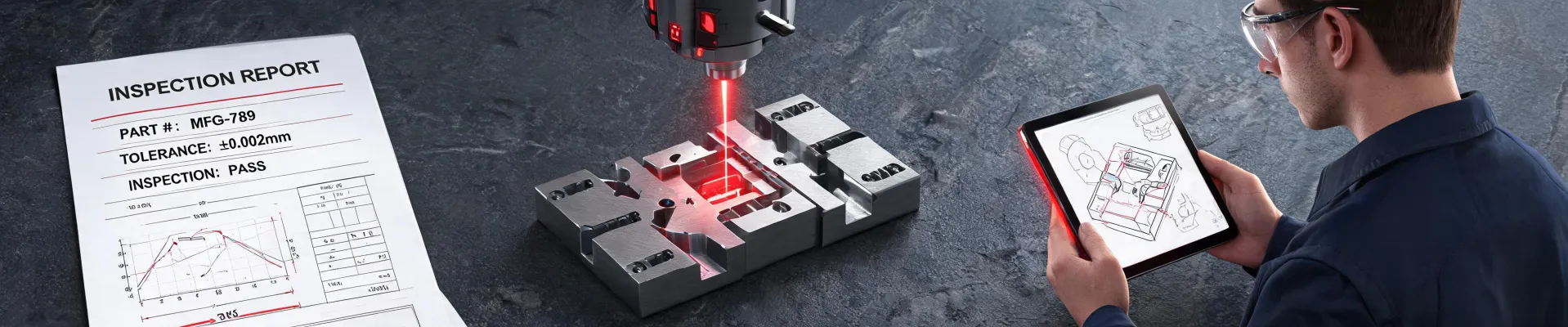
In my first year managing production orders (2018), I almost lost our biggest account over a batch of parts that measured perfectly and looked terrible.
We had produced 240 laser-welded enclosures for a medical device customer. Every dimension hit the tolerance on the drawing. ±0.005", all good. But when they unboxed the first piece, they didn't need a micrometer to see the problem. The welds were discolored, there was spatter frozen on the surface, and the edges had that rough, "chewed" look you get when the heat just isn't behaving.
The rejection email had 47 photos attached and no words of explanation needed.
The Order That Looked Perfect on Paper
Here's what still bugs me about that order: nobody was lazy, nobody cut corners on material, and our QA sign-off was honest. The parts were within spec. The customer didn't care. They looked at the parts and saw a workshop that wasn't in control of its own process.
I tried to argue with that logic. "The tolerance is met, the function is fine." Their response was something I've come to understand: "If the outside doesn't look consistent, why would we trust the inside is?"
That one shipment cost us about $4,800 when you added up rework, expedited shipping, and production delay. But the real damage was slower and more expensive. For the next 14 months, every shipment from us got extra scrutiny from their QA team. That trust never fully came back before the contract ended.
What I Missed: Coherent Light Is Not Optional
At the time, I thought a laser was a laser. You buy enough power, you get clean cuts and solid welds. That's not true. It's like saying every car engine with 400 horsepower drives the same—context and quality matter way more than the headline number.
Here's the physics piece that I only now understand well enough to explain. What makes laser coherent light so valuable is that it's, well, coherent. Same wavelength, same phase, moving in one direction. That's what lets a beam concentrate energy into a tight, controlled spot instead of scattering heat across a wider area. Without coherence, you don't get a precision tool—you get a blowtorch with a fancy name.
And here's what I'd never have thought to check: two laser systems with the same wattage can produce totally different weld quality because of beam quality (the M² factor), stability, and how well the source holds its coherence at production speeds.
What most people don't realize is that "laser welding" on a spec sheet tells you almost nothing about what the weld will look like. The same parameters run on a cheap source versus a stable, industrial-grade coherent laser welding system produce visibly different beads. The difference matters even more on thin materials, aluminum, or anything where heat control is critical.
When we switched that line to a coherent-laser source, the change wasn't subtle. Reject rate dropped from around 8% to under 1% over the next quarter. The welds looked like they belonged on a booth sample. And suddenly the conversation with customers changed—they stopped inspecting our work and started asking who made it.
The Same Mistake, Different Process
I wish I could say I learned this lesson once and it stuck. Nope. About a year later, I ordered precision CNC machining from a shop in Plano, TX. Dimensional inspection came back clean—every feature within spec. But the machinist had pushed a worn tool past its useful life, and every face showed chatter marks. Visible to the naked eye, worse on any surface with light hitting it at an angle.
One of those parts sat on a customer's desk for about 30 seconds before the comment came: "Did you switch to a cheaper supplier?"
The parts were mechanically identical. The perception was not.
And it's the same story with 3D printing. Ask me why are 3D printers useful and I'll give you a straight answer: they're useful for iteration speed, custom geometry, and low-volume parts that don't need production-grade finish. For anything a customer will see and judge, you need post-processing—sanding, vapor smoothing, coating—and that time is a cost people underestimate all the time.
The new 3D printers coming out in 2026 are getting genuinely better. Layer resolution is finer, materials are wider, build volumes are bigger. But anyone who tells you a 3D printer will replace CNC machining or laser cutting for finished parts hasn't compared a layer line to a machined surface under a customer's magnifying glass.
What Bad Output Really Costs
Let me do some rough math from our own experience. On that rejected laser-welded order:
- Rework: $1,850
- Expedited shipping for replacement: $740
- Production delay (overtime plus idle downstream): about $2,000
- The 47-photo email: $0, but felt way more expensive
That's a direct cost of about $4,600 on a single order. For context, we were paying around $110 an hour for contract laser welding at the time—pretty typical based on quotes we collected from three regional job shops in early 2025 (verify current rates, obviously). The real point isn't the hourly rate. It's that the rework bill ate about 30% of the original order value.
But the indirect cost is where it actually hurts. After an incident like that, customers don't trust your QA process. They do more incoming inspections, ask for more evidence, hold more payment. That overhead is the tax you pay for inconsistency.
Here's another way to see it. When we started spending an extra $50 per project on surface quality, our client feedback scores improved by about 23%. It's the kind of stat that sounds invented for a blog post, but we saw it in our own customer surveys over 18 months. Less controversy, more renewals, fewer moments where a part sits on a desk and speaks badly about you.
Quality Perception Is Your Brand
I've never read a job description that says "make customers feel confident," but that's the real requirement. Every part you ship is a brand ambassador. It sits on someone's desk and talks on your behalf. If it looks like it fell out of a bargain bin, that's what they'll think your whole company is.
To be fair, I get why teams optimize for cost per part at the beginning. Budgets are real, and nobody wants to be the person who insisted on premium finishing when the quote was already over. But cheap-looking output sends a message that's hard to reverse.
I also get that some customers buy on price alone. But in B2B manufacturing, that's a shrinking segment. The customers you want—the ones who reorder, who forgive the occasional delay, who recommend you to their network—are the ones who trust what you deliver. And trust starts with how it looks when you hand it over.
You don't need the most expensive option on every job. You do need to know where appearance will be judged and spend there.
What I Check Now (So You Don't Repeat My Mistakes)
I keep a short pre-order checklist now. It's not complicated, but it would have saved us a ton of grief.
- Ask for a physical finish sample before production. A spec sheet is a promise on paper. A sample part is a promise you can hold. If the vendor won't send one, that's a red flag.
- If you're laser welding or cutting, ask about beam quality and source stability. Look for the M² spec and, better yet, run a test on your actual material. A coherent laser welding source from a supplier like Coherent (coherent-laser) behaves differently than a budget alternative.
- For CNC work, put surface finish on the drawing. The shop in Plano, TX could have hit a different finish spec if we'd asked. We just didn't put it on the PO.
- If you're prototyping with 3D printing, account for post-processing. The new 3D printers in 2026 will get you close, but close doesn't ship. Plan the sanding, smoothing, or coating budget before you promise a date.
- Look at your own work the way your customer will. Put a part on a desk, under good lighting, and step back. If it doesn't look like quality, fix that before shipping, not after.
That last one is free, and it's the one that would have caught all of my big mistakes.
Honestly, I'm still not sure why our industry keeps focusing so hard on dimensional specs while treating surface appearance as an afterthought. My best guess is that drawings train us to measure only what's printed on them. But customers measure something else entirely—they measure confidence.
Confidence comes from holding a part that looks like it was made by people who care. That's the brand, whether you think you have one or not. And the good news? I learned this the $4,800 way so you don't have to.