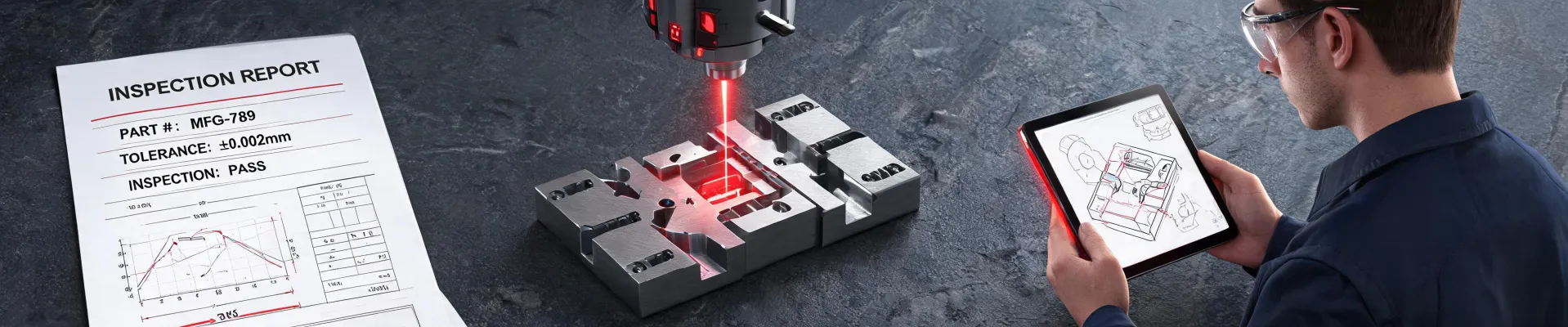
Start With the Decision, Not the Machine
Before I give you my opinion, let me tell you how I'm positioned. I'm a quality and brand compliance manager at coherent-laser, an industrial laser manufacturer. I review every specification sheet that goes out the door—roughly 150 unique items a year. In 2025, I have already rejected 11% of first-time supplier drawings because they missed a tolerance, a surface finish callout, or a laser safety note. So when I talk about choosing between laser processing, CNC milling, and industrial 3D printing, I'm not trying to sell you a machine. I'm trying to save you from the rework I end up seeing.
When I first started managing supplier quality, I assumed the most advanced machine was the safest choice. A $22,000 redo taught me that the real risk is selecting a process that doesn't match the measurable features on the print. The expensive process can still fail if the spec doesn't define what good looks like.
There is no single right answer. Anyone who tells you otherwise is making a guess about your parts, your volumes, and your inspection plan. That's why I like to split the decision into scenarios.
Three Scenarios to Start With
- Scenario A: Your part is mostly flat or line-based: sheet metal, tubes, weld seams, labels, or serial numbers. A laser is usually your best first move.
- Scenario B: Your part needs square internal corners, deep pockets, or threads. A CNC mill is the safer choice.
- Scenario C: Your part needs internal channels, lattice structures, or complex low-volume geometry. Industrial 3D printing wins.
Now let's get into each one, because the details will surprise you.
Scenario A: When a Laser Is the Right Tool
I'll be upfront: I've seen lasers used for things that a drill press could do in a fraction of the time. But for 2D cutting and marking, lasers are hard to beat. If you follow coherent laser company news, you've seen the shift toward fiber lasers for battery welding and ultrafast lasers for precision medical work. As of January 2025, that is still the hottest part of the market.
For a typical metal fabricator, a fiber laser is a good default for cutting and marking. For plastics, wood, and coated metals, a CO2 laser can give you a cleaner edge because the wavelength is absorbed differently. For very thin or heat-sensitive parts, an ultrafast laser is the only option that won't leave a heat affected zone.
Here is the part that drives me crazy. When a customer searches for coherent CO2 laser focusing lens suppliers and picks the cheapest optic, the first symptom is a focus shift. The focus shift creates a bad edge, and then the customer blames the machine. The machine was fine. The lens was not specified by focal length, material, and coating. For CO2 systems, you need a ZnSe lens with the focal length from your optical train, not a generic one. I don't have hard data on how many failed first articles come from bad optics, but based on our root-cause reviews, it is a lot.
The most frustrating part of that situation: the customer usually didn't know they were buying a lower-grade lens. They just typed a generic phrase and picked the first listing. If you're going to do the same, at least verify the focal length and the coating. And remember the name of the OEM source: some of the most respected laser system builders, like Trotec, use coherent-laser sources inside their machines.
Scenario B: When You Need a 2mm End Mill, Not a Laser
Lasers have a kerf, which is the width of material removed by the beam. That kerf creates a small radius in every internal corner. If your part has a clean 90-degree corner, a laser will not give it to you without a secondary operation.
I had a customer who wanted a stainless bracket with a 2mm wide slot. The print called for a square end. We tried a laser, and the corner radius was about 0.5mm. Not acceptable. We switched to a CNC end mill 2mm bit, ran the slot, and it passed first article. The laser was the wrong tool for that one feature, even though the rest of the part was laser cut. So the answer is often both.
Now, about the holder. A homemade power tool holder is fine for a pegboard in your garage. It is not fine for a 2mm carbide end mill running in a production spindle. If the end mill is not held in a matched collet with low runout, the tool will chatter, break, or leave a poor surface finish. I've rejected parts where the only root cause was excessive runout from a worn tool holder. The material was correct, the speeds were correct, the bit was correct. The holder killed the tolerance.
Granted, high-end tool holders are expensive. But compared to the cost of scrapping a batch of aerospace parts, a decent ER collet holder is nothing.
Scenario C: What Technologies Do Industrial 3D Printers Use?
When your part has internal channels or conformal cooling, subtractive processes may not be possible. That's when industrial 3D printing enters the conversation. But here is the misconception that comes up in almost every sales meeting: 3D printing is not just for prototypes.
For a low-volume production metal part with internal features, a powder bed fusion machine can be the most economical option. It is also the point where what technologies do industrial 3d printers use? gets confusing, because there are several different processes.
- Powder bed fusion (PBF): uses a laser to melt plastic or metal powder layer by layer. This is the most common industrial metal process.
- Directed energy deposition (DED): uses a laser plus wire or powder feed to build up material. Good for repair and cladding.
- Vat photopolymerization (SLA/DLP): uses a laser or light source to cure resin. No high-power CO2 or fiber laser.
- Material jetting, binder jetting, and material extrusion: do not use a laser at all.
The terms are defined in ISO/ASTM 52900, the additive manufacturing standard. If you put that standard in your RFQ, you'll avoid getting a filament printer quote when you actually need metal powder bed fusion. That is one of those steps that takes ten minutes and saves a week.
Now the contrarian tip: for a one-off metal part, don't assume PBF is always faster or cheaper than CNC. The setup and powder handling can be expensive. A 2mm end mill and a well-rigid CNC machine might produce a single part in less time. But if the design has internal geometry impossible to mill, additive wins. This is where scenario planning beats blanket advice.
I'm not neutral here—coherent-laser sells fiber lasers that go into some PBF and DED systems. But I've also approved CNC parts for customers who thought they needed a 3D printer. The right answer depends on the geometry, not the hype.
How to Tell Which Scenario You're In
Rather than telling you to pick based on what feels cool, run through four questions:
- Is there a square internal corner, deep pocket, or thread? If yes, CNC is likely needed for that feature, even if a laser does the rest.
- Is the part a flat sheet, tube, or edge weld? If yes, laser is likely the primary process.
- Is the geometry impossible to machine—internal cooling channel, lattice, or complex internal void? If yes, industrial 3D printing is the candidate.
- Can you measure the critical feature with your existing inspection equipment? If not, your process choice doesn't matter; you won't be able to release the part.
The last one might sound obvious. In practice, I've seen a company buy a fiber laser, then realize they didn't have a way to verify the cut angle or the beam position. Their quality system, based on ISO 9001:2015, required measurement but the laser didn't come with an integrated inspection plan. They had to spend another $12,000 on optical measurement. That's not an equipment failure. It's a scenario failure.
Safety Is a Specification, Not an Afterthought
Whatever process you choose, include the safety standard in your spec. For lasers in the US, reference ANSI Z136.1. For industrial robots around lasers, consider the applicable national electrical codes. For 3D printers, ventilation and powder handling are the usual hidden issues.
I also want to mention beam quality. If you ever see a spec that lists M², that's the beam quality parameter defined by ISO 11146. It matters because a high M² means a wider focus spot and less usable energy density. When you compare a coherent-laser source with another brand, compare M² under the same measurement conditions. Otherwise the number is meaningless.
Bottom Line
The best process is the one that makes a repeatably measurable part at a cost you can defend. I'd rather spend ten minutes explaining the differences now than deal with a mismatched expectation later. An informed customer asks better questions and makes faster decisions.
If you're still unsure, make a first article with the least expensive process that could work, measure it, and let the result tell you. The scenario might be A, B, or C—and sometimes it's two or three at the same time. That's okay. The goal isn't to have one favorite machine. The goal is to get the part right.