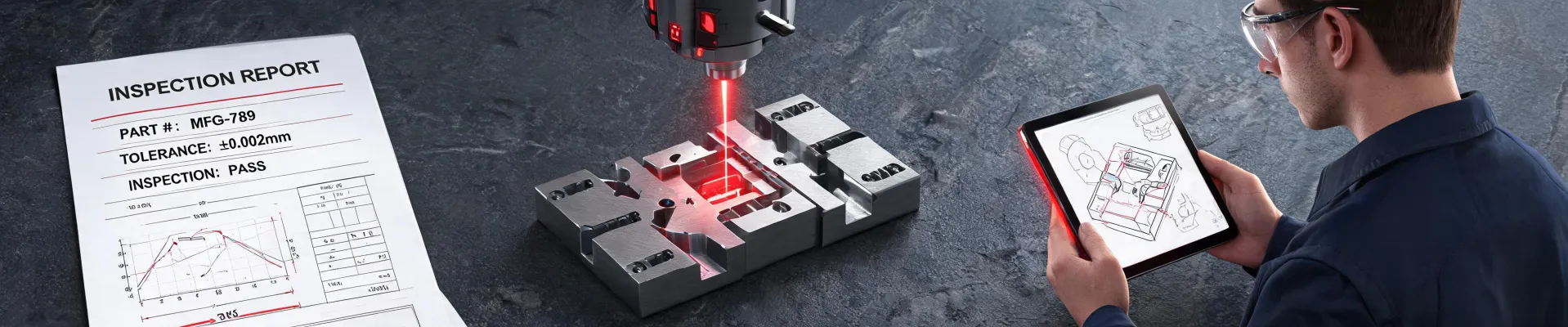
A factory floor shouldn't smell like burnt Styrofoam if you're running a fiber laser. That was my first clue that I had made a mistake. Not a small one. A $3,200 mistake that involved a coherent laser cutter, a batch of rushed orders, and a customer who was about to miss their biggest trade show.
But let me back up. I'm the guy who documents screw-ups so the new hires don't have to rediscover them on their own dime. I've been handling custom manufacturing orders for about six years now. In that time, I've personally made—and more importantly, documented—some significant errors. Roughly $18,000 in wasted budget, give or take. The worst part is that I knew better.
This one started because I thought I was being clever. A customer wanted a prototype: some acrylic display stands, a few aluminum brackets, and a few parts that needed to be cut from high-density foam. I looked at the mix and thought, "I can run this all on the same production line."
I couldn't. And the reason why is a lesson in why you can't just treat every cutting tool like it's the same thing.
Part 1: The Myth of Universal Manufacturing (Where I Went Wrong)
In my first year (2017), I made the classic error of assuming that all digital fabrication tools spoke the same language. I had just bought a Coherent Monaco laser—a fantastic ultrafast laser for micromachining. I'd also just had our old CNC lathe machine serviced. And someone in the office had a hot cutting tool for styrofoam set up for packaging foam.
I thought: "Same CAD file, different output. Speed, power, precision. What could go wrong?"
Well, a lot. The CNC lathe machine doesn't care about thermal distortion in the same way a laser does. The hot cutting tool for styrofoam has zero kerf control. And the coherent laser cutter with the Monaco source—that thing is a precision instrument that melts, burns, or vaporizes material. It's not cutting in the physical sense. It's a heat process.
I only believed that after ignoring it and eating that $800 mistake on the foam. The foam melted, the edges turned yellow, and the customer sent me a photo with a single question mark. That was the reverse validation I needed, and it was expensive.
Part 2: The Bad Day with the Foam Order
In September 2022, I submitted a quote for a mixed order: aluminum parts, acrylic signs, and—critically—a custom foam insert for a tool case. The aluminum parts would go on the CNC lathe machine. The acrylic would go on the coherent laser cutter. And the foam? I figured I'd just use the hot cutting tool for styrofoam. Simple stuff.
I didn't consider the edge quality. With the laser, you get a clean, slightly melted edge. With the hot wire, you get a rough, melted bead. With the CNC lathe machine, you get chips, not melt. Put them side by side? They don't match.
The customer had specified the foam had to match the aluminum's finish. Facepalm. They weren't looking for precision; they were looking for visual consistency. I had specified three different processes and gotten three different aesthetics.
When I compared the hot wire cut foam and the laser-cut acrylic side by side, I finally understood why the details matter so much. The foam looked like a burned marshmallow. The acrylic looked like glass.
I had 2 hours to decide how to fix it before the customer's deadline for the trade show. Normally I'd get multiple quotes, but there was no time. I ended up re-running the foam on the coherent laser cutter anyway—even though it's not the ideal tool for thick foam—just to get a consistent edge finish. It worked, but it was slower and used more energy.
Cost of the redo: $350 in time plus the rush shipping. Still cheaper than losing the account, but man, I felt stupid.
Part 3: The 3D Printing Diversion (SLS vs. MJF)
Around the same time, I was exploring additive manufacturing for the same customer. They wanted a small run of functional prototypes, and I was comparing SLS vs MJF 3D printing technologies. This was the 'hot cutting tool' of the digital age—everyone was talking about it.
But I was stuck in my old mindset. I kept trying to run everything through the same pipeline. I thought:"Why not just use the laser cutter for everything? Or the 3D printer?". It's a trap I see a lot of engineers fall into.
The short list of what I learned comparing SLS vs MJF 3D printing:
- SLS (Selective Laser Sintering): Great for complex geometries, but the surface finish is grainy. It uses a laser to sinter nylon powder, so it's technically a 'laser' process, but it's not a cutter.
- MJF (Multi Jet Fusion): Faster than SLS for some parts, and the surface finish is better. But it uses an inkjet array, not a laser. Totally different process.
I originally tried to cut parts from sheet material with a coherent laser cutter and then 3D print the complex brackets. But the tolerances didn't match. The laser-cut hole was exactly 10.00 mm. The 3D-printed hole was 10.12 mm due to shrinkage. In a tolerance stack-up, that 0.12 mm kills the assembly.
"I only believed in the 'one tool to rule them all' myth after ignoring the experts and costing myself a full week of rework." That's the note I wrote in our team's post-mortem.
Part 4: The Real Checklist (No More Assumptions)
After the third rejection in Q1 2024, I created our pre-check list. It's not fancy, but it works. Now, before we quote any job that mixes a CNC lathe machine part with a laser-cut part, we ask:
- Are the materials compatible with the machine? (Don't put foam on a fiber laser unless you want smoke.)
- Will the edge finish match? (Hot wire vs. laser vs. mill—three different looks.)
- What's the tolerance? (A Coherent Monaco laser can hit ±5 microns. A hot knife? ±1 mm. They are not the same.)
- Does the customer even care about the difference? (Sometimes they don't. But ask first.)
We've caught 47 potential errors using this checklist in the past 18 months. Not all of them were show-stoppers, but a few would have been expensive. One was a $1,200 order of parts where the spec called for a 'smooth' finish. The coherent laser cutter gives a smooth finish on acrylic. The hot cutting tool for styrofoam? Not so much.
Final Thought: The Best Tool is the One That Matches the Job
Here's the bottom line. When I was starting out, the vendors who treated my $200 orders seriously are the ones I still use for $20,000 orders. And the same goes for my own customers. Small doesn't mean unimportant—it means potential.
But respecting the customer also means respecting the physics. You can't force a coherent laser cutter to be a hot knife, and you can't force a CNC lathe machine to be a 3D printer. The people who do that—who assume one process fits all—are the ones who end up with burnt foam and a calendar full of re-dos.
So next time you're comparing SLS vs MJF 3D printing, or debating whether to use a laser or a lathe for a metal part, remember my story. Don't be the guy with the expensive smoke cloud. Be the guy who asks the right questions first.
A lesson learned the hard way, but shared so you don't have to.